
How to select MCB miniature circuit breakers for 1P,1P+N, and 2P configurations?
AC Circuit Breaker Curve C 10A 2P 6kA
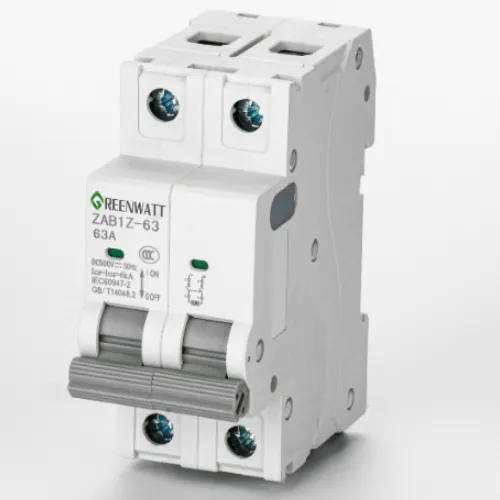
Q1: What are 1P,1P + N, and 2P?
1P: Only the live wire L pole is protected.
1P + N: The live wire L is equipped with a thermal-magnetic trip unit; the neutral wire N lacks a trip unit and only mechanically interlocks with L.
2P: Both poles are fitted with thermal-magnetic trip units. Suitable for L + N configurations or two live conductors (e.g., L1 + L2 or DC ± poles).
Application scenarios: 1P: Common residential lighting and socket branch circuits.
1P + N: Outdoor sockets, humid environments, and power tool sockets requiring complete N-phase disconnection.
2P: High-end appliances, medical equipment, electrical workbenches, or DC systems.
Q2: What are the shortcomings of the internal protective structure?
The 1P configuration features only a bimetallic strip (thermal tripping) and electromagnetic coil (magnetic tripping) on the L pole. The 1P + N configuration installs tripping elements exclusively on the L pole, with the N pole serving as a "slave contact." The 2P configuration integrates both bimetallic strips and electromagnetic coils on both poles, triggering tripping when either pole becomes abnormal.
Application scenarios requiring real-time overload detection of two conductors (e.g., DC ± phase or dual thermal phases) demonstrate that 1P or 1P + N configurations are insufficient, necessitating 2P implementation. Provided that N poles achieve synchronous disconnection, the 1P + N configuration remains adequate.
Q3: Why do some systems insist on 'disconnecting even when connected to N'?
Complete elimination of residual voltage ensures safer equipment handling for maintenance personnel. When lightning strikes or induced overvoltage enters the circuit, the N terminal can be isolated. For systems such as IT, TNS, and TT, the N terminal is not shared with ground, and retaining the N terminal may introduce leakage current pathways.
Application scenarios include outdoor advertising light boxes, streetlight control boxes, mobile distribution boxes in rural tourism facilities and construction sites, as well as laboratories and medical sockets, where "full-pole isolation" is required.
Q4: Is 2P always superior to 1P + N?
The 2P bipolar dual-belt protection offers the most comprehensive functionality, but comes with higher costs, larger size, and more pole positions. If your system only requires monitoring the L-side current while the N-side potential is close to ground and N-side current monitoring is unnecessary, the 1P + N configuration can provide equivalent isolation performance with cost-effectiveness.
Application scenario with high budget sensitivity + standard residential use → 1P configuration for lightning protection, moisture resistance, and easy maintenance → 1P + N dual conductors requiring protection or high-end equipment → 2P
Q5: Can 1P + N configuration still be used in TNC or TNCS systems?
This is feasible but of limited significance, as N and PE in the TNC system share the same conductor (PEN). Under this grounding configuration, 1P already meets the minimum regulatory requirements. For future retrofitting or maintenance convenience, 1P + N can be optionally configured as an advanced setup.
Q6: Is it feasible to use 1P + N as 2P to protect two live wires?
No! The N pole of a 1P+N configuration lacks a thermal-magnetic trip unit. If the live wire experiences overload or short circuit, it will not operate independently, effectively losing its protective function. To ensure protection for two live conductors, a genuine 2P configuration must be employed.
Q7: What are the specific steps for model selection?
Confirm grounding method: TNC/TNCS → 1P; TNS, TT, IT → at least 1P + N.
Determine requirements: Is it necessary to protect the current of a second conductor simultaneously? If yes, 2P is required.
Verify short-circuit capacity: On-site fault current ≤ Circuit breaker Icu/Ics.
Balanced budget and space: 1P for maximum savings, 2P for maximum capacity; 1P + N for intermediate solutions.
Refer to manufacturer requirements: Certain imported household appliances or medical devices explicitly mandate "full-pole isolation," which must be implemented as 1P + N or 2P.