
What Is a Battery Energy Storage System (BESS)? A Practical Guide to How It Works and What Matters
BESS stands for Battery Energy Storage System. It is often described as a large battery, but that description is only part of the story.
A complete BESS does more than store electricity. It can charge when electricity is available, store that energy, and discharge it when the power is needed. Depending on the project, a BESS may be used with solar power, commercial and industrial loads, microgrids, or the utility grid.
The basic idea is simple:
Charge → Store → Discharge when needed.
What makes a BESS useful is the ability to control when and how stored electricity is delivered. This makes battery storage different from simply installing additional generation capacity.
What Is the Difference Between ESS and BESS?
ESS stands for Energy Storage System. It is a general term covering different ways of storing energy.
Depending on the technology, an energy storage system may use batteries, pumped hydro, compressed air, flywheels, thermal storage, or other approaches.
BESS is one type of ESS that uses batteries as the main energy storage medium.
In simple terms:
ESS is the broader category, while BESS is a battery-based energy storage system.
Today, BESS is widely discussed because battery systems can be deployed in different locations and configured for different power and energy requirements. They can also respond quickly when the system needs more or less power.

Why Do We Need Battery Energy Storage?
One of the basic challenges of the power system is that electricity generation and electricity consumption do not always happen at the same time.
Solar power is an easy example.
Solar generation is normally higher during daylight hours, while electricity demand may increase later in the afternoon or evening. Without storage, electricity generated at one time cannot simply be saved for later use.
BESS provides a way to shift part of that electricity from one period to another.
A Simple Solar + BESS Example
During the day: Solar generation is high → part of the electricity is used immediately → surplus electricity charges the BESS.
In the afternoon: Solar output begins to fall → the BESS can start discharging according to the control strategy.
In the evening: Solar generation may be unavailable → stored electricity can continue to support selected loads or the grid.
In this sense, a BESS does not create new electricity. It changes when stored electricity is available for use.
Where Are BESS Systems Used?
BESS applications are not limited to large utility-scale projects. The required configuration depends on the power demand, operating conditions, electricity market, and purpose of the project.
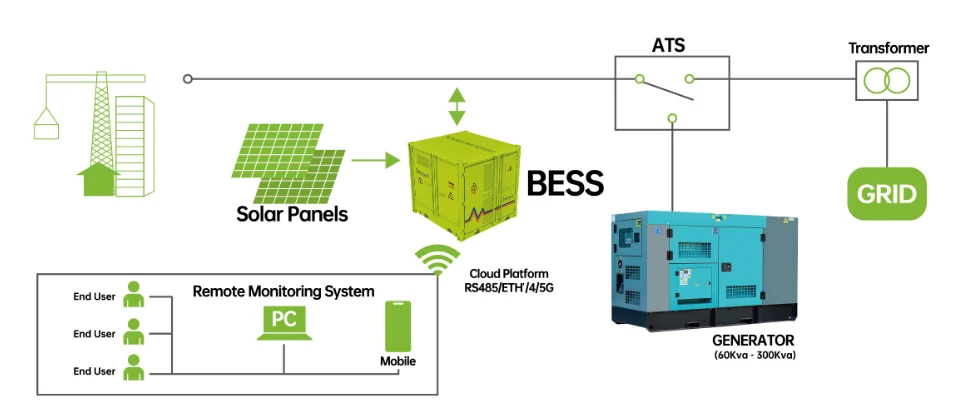
Solar and Wind Power Projects
Renewable energy generation can change with weather and time of day. Battery storage can help move some generated electricity to a later period when it is more useful.
For a solar project, for example, the BESS may charge during periods of high solar output and discharge later based on the project's operating strategy.
This does not make renewable generation completely constant. Instead, the storage system adds another layer of flexibility between electricity generation and consumption.
Commercial and Industrial Energy Storage
Factories, commercial buildings, and other large electricity users may have significant differences between their peak and off-peak electricity demand.
A BESS can be programmed to charge during selected periods and discharge during periods of higher demand.
Depending on the local electricity tariff, this may help reduce peak demand or shift electricity consumption away from more expensive periods.
For this type of project, battery capacity alone does not determine the economic value of the system. The load profile, electricity tariff, operating schedule, and battery degradation also need to be considered.
Grid Support and Ancillary Services
BESS can also provide fast power adjustments for the grid.
For example, grid frequency changes when electricity generation and demand are not perfectly balanced. A properly configured battery system can rapidly increase or decrease its power output to help respond to these changes.
This fast response is one of the characteristics that makes batteries useful for certain grid services.
Backup Power and Microgrids
In some applications, BESS can provide backup power for selected loads when the main power supply is unavailable.
The actual backup capability depends on the electrical architecture, control system, battery capacity, load size, and required backup duration.
For critical-load applications, the design therefore needs to consider more than battery capacity. Switching logic, protection, power conversion, load priority, and operating conditions are also important.
Why Is BESS Becoming More Important?
Energy storage itself is not a new idea. What has changed is the growing need for flexibility in modern power systems.
Solar and wind generation can vary with weather conditions. Electricity demand also changes throughout the day.
This creates a practical need to control not only how much electricity is available, but also when it is available.
BESS can participate in this process by storing electricity during one period and releasing it during another.
This is why BESS is being considered for applications such as renewable energy integration, peak demand management, energy shifting, grid services, and backup power.
Do Not Judge a BESS by Battery Capacity Alone
One of the easiest mistakes when comparing BESS projects is to look only at the MWh figure.
A typical BESS specification may look like:
10 MW / 40 MWh
The two numbers describe different things.
- MW indicates the power capability of the system.
- MWh indicates the amount of energy that can be stored.
- Duration indicates how long the system can theoretically operate at a specified power level.
For example, a 10 MW / 40 MWh system has a nominal duration of 4 hours when operating continuously at 10 MW.
This distinction is important when comparing different BESS configurations.
A 20 MWh system configured as 10 MW / 2 hours is not equivalent to a 20 MWh system configured for a different power rating and operating profile. The same amount of stored energy can serve different purposes depending on how quickly it can be delivered.
Key BESS Parameters You Should Understand
The original list of BESS indicators can be simplified. In an actual project, some parameters are much more important than others, and their importance depends on the intended application.
1. Power Rating
Power rating is normally expressed in kW or MW.
It describes how much power the BESS can deliver or absorb at a given time.
A system designed for rapid grid response may place greater emphasis on power capability and response performance, while an energy-shifting project may place more emphasis on energy capacity and duration.
2. Energy Capacity
Energy capacity is normally expressed in kWh or MWh.
It describes how much electrical energy the system is designed to store.
However, rated energy capacity should not automatically be treated as the amount of energy available for every operating condition. Usable energy can be affected by the permitted state-of-charge range, operating temperature, system efficiency, degradation, and control strategy.
3. Energy Duration
Duration connects power and energy capacity.
For example:
10 MW / 20 MWh = 2-hour duration
10 MW / 40 MWh = 4-hour duration
This is why both MW and MWh should be considered when evaluating a BESS.
4. Round-Trip Efficiency
Round-trip efficiency describes how much usable energy can be recovered compared with the energy supplied during charging.
Energy is lost during charging, storage, conversion, and discharge. The losses can come from the battery itself, power electronics, cooling equipment, controls, and other auxiliary systems.
For project evaluation, the important point is not to assume that every BESS has the same efficiency. The actual figure depends on system design, operating conditions, test methods, and the point at which efficiency is measured.
5. Response Time
Response time describes how quickly the system can change its output after receiving a control command.
This can be particularly important for frequency regulation and other applications requiring rapid power adjustments.
For a simple peak-shaving project, response time may not have the same importance as it does for a grid-support application.
6. Depth of Discharge (DoD)
DoD stands for Depth of Discharge. It describes how much of the available battery capacity has been used during a discharge cycle.
For example, if a battery starts at 100% state of charge and is discharged to 20%, the discharge depth is 80%.
DoD should always be considered together with battery life and the operating strategy. Deeper cycling, temperature, charging and discharging rates, and other conditions can all affect battery degradation.
7. Cycle Life
Cycle life describes how many charge and discharge cycles a battery can complete under specified test or operating conditions.
There is an important detail here: a cycle-life number should not be viewed in isolation.
When comparing two BESS suppliers, it is useful to check the conditions behind the stated cycle life, including DoD, operating temperature, charging and discharging rate, and the definition of end-of-life.
8. Operating Temperature
Temperature has a direct effect on battery performance and aging.
That is why thermal management is an important part of BESS design, especially for installations in regions with high ambient temperatures.
The installation environment should be considered during system design rather than treated as an issue to solve after the equipment has been selected.
9. Safety
BESS safety is not simply a question of whether the battery itself is safe.
A complete system needs to consider electrical protection, thermal management, monitoring, fault detection, isolation, emergency response, fire protection, and the requirements that apply to the specific installation.
The exact safety design depends on the battery technology, system size, installation environment, applicable codes and standards, and project requirements.
How Should You Evaluate a BESS Project?
If you are new to battery energy storage, you do not need to start with dozens of technical specifications.
Start with five practical questions:
What problem is the BESS supposed to solve?
Is it for peak shaving, solar energy shifting, backup power, grid services, or another application?
How much power is required?
This determines the required power rating, normally expressed in kW or MW.
How much energy needs to be stored?
This determines the required energy capacity, normally expressed in kWh or MWh.
How long should the system operate?
A 2-hour, 4-hour, or longer-duration system can serve different project requirements.
What are the operating conditions?
Consider ambient temperature, charging and discharging frequency, DoD, expected cycle life, maintenance requirements, safety requirements, and the electrical environment.
Once these questions are clear, it becomes much easier to evaluate the battery technology, PCS, BMS, EMS, cooling system, protection equipment, and overall system configuration.
BESS Is More Than a Large Battery
The easiest way to understand BESS is not to think of it simply as a container full of batteries.
A BESS is a controlled energy storage system that allows electricity to be stored and delivered at the time, power level, and operating conditions required by the application.
That is also why a BESS specification cannot be judged by MWh alone. Power rating, energy capacity, duration, efficiency, response time, DoD, cycle life, temperature, and safety all need to be considered in the context of the project.
In the next part, we will look inside a BESS and explain what the battery system, BMS, PCS, EMS, thermal management system, and safety system each do—and how these components work together during charging and discharging.